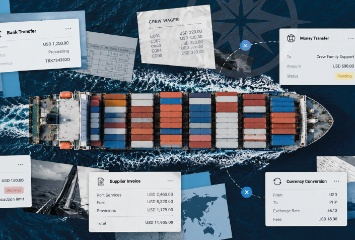
Cash on board costs a shipping company far more than the wages it carries: it has to be ordered, delivered, insured, stored, counted, handed out and reconciled, and every step takes time from the master and the office and carries its own risk. Most companies know what they pay their crew. Fewer know what it costs to pay them.
Cash on board is a good place to start. On paper it is a simple line: the wages a vessel needs in hand for the next port. In practice it is a chain of small jobs, each one taking time from the master and the office, and each one carrying a little risk. None of them looks expensive on its own. Together they add up to a cost that rarely shows on anyone's report.
What happens before the cash reaches the ship?
The cash has to be ordered. Someone in the office works out how much each vessel will need, in which currencies and in which denominations, and places the order with a supplier or bank in good time for the port call.
Then it has to be delivered. The cash is shipped to the port and handed over to the vessel, which means arranging a courier, matching the delivery to the ship's schedule and making sure someone with authority is there to sign for it. If the port call moves, the delivery moves with it.
And it has to be insured. Cash in transit and cash held on board are exposed in a way that a bank transfer is not, so the cover has to be arranged, paid for and kept up to date.
What does it cost once the cash is on board?
Once it is on the ship, the cash has to be stored securely. The safe becomes the master's responsibility, along with knowing who has access to it and what is inside at any moment.
Then it has to be counted and handed out. On payday the master, or an officer, counts the money, pays each crew member, records who received what and gets a signature. It is careful, slow work, and it happens at the same time as everything else a master has to do in port.
Finally, it has to be reconciled. The office checks what was ordered against what was delivered, paid out and left over, and chases any difference. Leftover cash has to be carried forward, returned or accounted for, and a small mistake on board can mean a long thread of emails ashore.
The cost of cash on board, step by step
| Step | Who does the work | Hidden cost or risk |
|---|---|---|
| Ordering | Office | Forecasting amounts, currencies and notes before the crew list is final |
| Delivering | Office and master | Couriers, port timing and re-arranging when the port call moves |
| Insuring | Office | Cover for cash in transit and on board |
| Storing | Master | Safe custody and control of access |
| Counting and handing out | Master or officer | Time on payday, signatures and counting errors |
| Reconciling | Office | Matching orders, payouts and leftovers, and chasing differences |
Where are the hidden risks?
Each step has its own:
- Loss or theft, in transit or on board, which is why the insurance is needed in the first place.
- Counting errors, which are easy to make and hard to trace after the ship has sailed.
- Wrong amounts, when the order is placed before the final crew list or the exchange rate is known.
- Cash left over or short, when plans change between ordering and payday.
There is also a cost to the crew. Seafarers who are paid in cash have to keep it safe themselves, and then find a way to get it home to their families.
How much of this work can disappear?
Most of it. When crew are paid directly and can access their wages wherever they are, there is no cash to order, ship, insure, lock away, count or reconcile. The money goes straight to the person who earned it, and they can spend it, withdraw it or send it home without the master handling a single note.
For the master, that means time back in port. For the office, it means fewer orders to place, fewer deliveries to chase and fewer differences to explain. For the crew, it means pay that is safer and easier to use.
How can you reduce cash on board without disrupting the master?
You do not have to switch everything at once. A few practical steps make the change easier:
- Start with one vessel. Pick a ship where the master is open to trying it, and learn from that before going fleet-wide.
- Keep a smaller cash float. Crew can still have some cash for shore leave while most of their wages are paid directly.
- Explain it to the crew first. Show them how they will see their pay, how they can use it in port and how their families will receive it.
- Give the master a simple routine. Payday should take less of their time, not more, so make sure the new process is clear before the first payment run.
- Look at the whole chain. When you compare costs, count the ordering, delivery, insurance, storage, counting and reconciling, not only the cash itself.
The real question
Cash on board works, and many fleets have run it for years. The question is not whether it can be done, but how much time and risk it quietly takes from the people who do it.
When crew can be paid directly and reach their wages wherever they are, much of that work simply goes away.
Sources
- ShipMoney, "Financial drag: the hidden costs of paying crew", editorial brief, October 2026.