While much of the industry’s focus remains on hardware and alternative fuels, a critical digital transformation is occurring in the shipping companies’ operational agility and financial security.
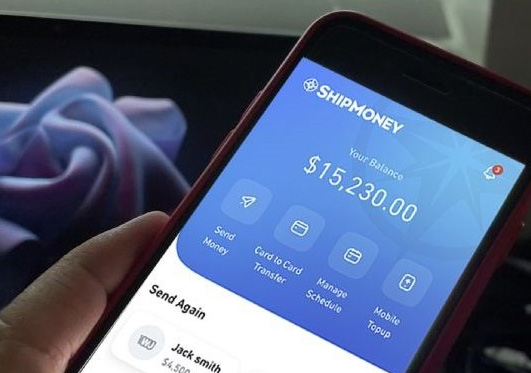
ShipMoney is a central figure in this transition, moving beyond traditional software to provide a holistic ecosystem for maritime payments and payroll. By eliminating the logistical burden of “Cash-to-Master” and leveraging AI to enhance human expertise.
In this interview, Matthew Sankary, Chief Strategy Officer at ShipMoney, discusses how digitalization serves as a cornerstone for ESG goals, the evolving role of the maritime workforce, and the company’s vision for a fully integrated, tech-driven future by 2030.

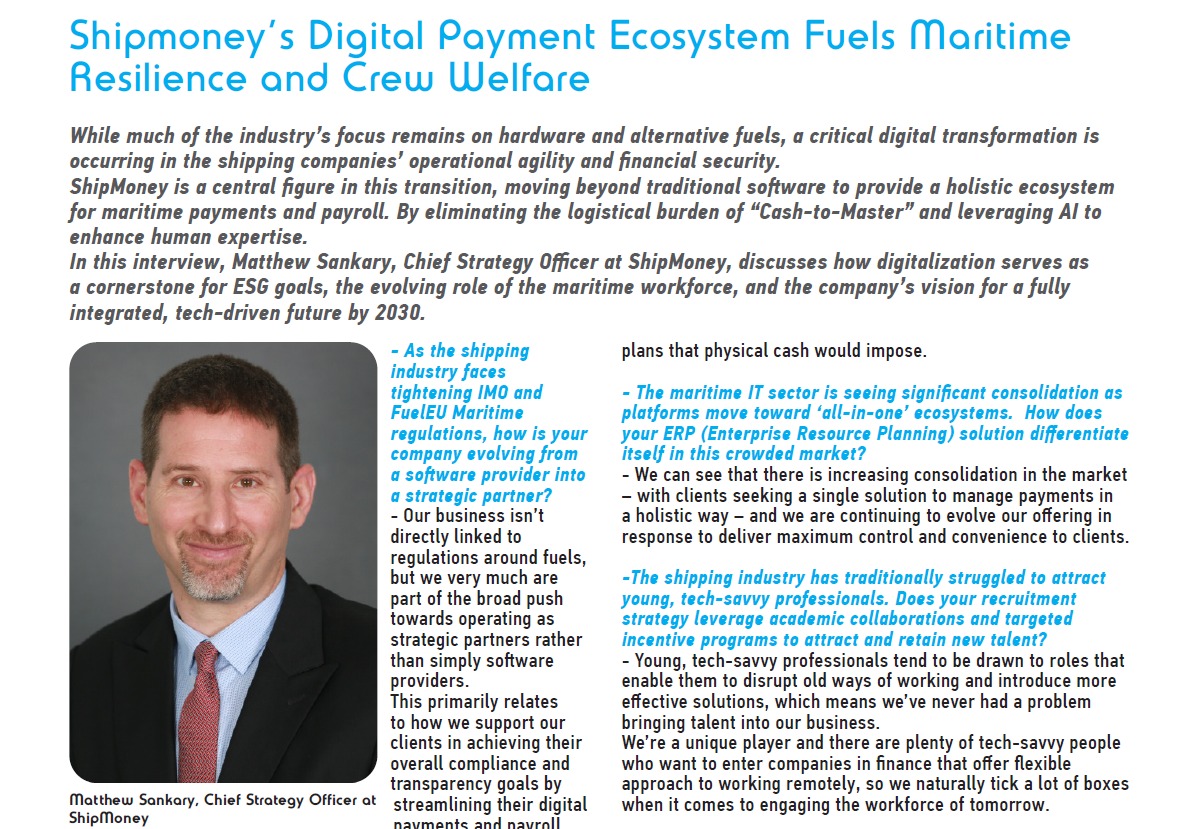
Matthew Sankary, Chief Strategy Officer at ShipMoney
- As the shipping industry faces tightening IMO and FuelEU Maritime regulations, how is your company evolving from a software provider into a strategic partner?
- Our business isn’t directly linked to regulations around fuels, but we very much are part of the broad push towards operating as strategic partners rather than simply software providers.
This primarily relates to how we support our clients in achieving their overall compliance and transparency goals by streamlining their digital payments and payroll processes.
By streamlining processes and integrating bespoke solutions, we become more integrated into clients’ overall way of operating and even support them in meeting sustainability goals and ESG commitments through the shift to digitalisation.
Through bespoke reporting that solves complex challenges, our strategic approach is tailored to each individual company.
- There is a common debate about AI replacing human roles. In your view, how does the integration of AI-driven predictive maintenance and voyage optimization shift the required expertise of the maritime workforce?
- AI certainly will have an important role to play but it’s important to recognise that it’s less about replacing humans and more about enhancing and augmenting their current skillsets.
Where time is spent on time-intensive manual reporting, we’d expect some level of automation to support teams. Fraud monitoring is another area where AI will prove valuable, while customer service bots will most likely increasingly deal with simpler troubleshooting issues.
The expertise of the maritime workforce will adapt in the sense that making effective use of AI solutions will become more important, while time will be freed up to address more creative tasks that can add greater value.
- How do your digital solutions help clients quickly reroute or re-calculate risks in a world where ‘just-in-time’ delivery is increasingly threatened by global tensions?
- By offering digital payment solutions that avoid the need to rely on cash-to-master, our solutions ensure that shipping companies are not required to allocate significant working capital to ships.
In a disrupted landscape, our solutions mean that shipping companies can distribute funds quickly and easily in line with requirements, without the constraints on rerouting or adjusting plans that physical cash would impose.
- The maritime IT sector is seeing significant consolidation as platforms move toward ‘all-in-one’ ecosystems. How does your ERP solution differentiate itself in this crowded market?
- We can see that there is increasing consolidation in the market – with clients seeking a single solution to manage payments in a holistic way – and we are continuing to evolve our offering in response to deliver maximum control and convenience to clients.
- The shipping industry has traditionally struggled to attract young, tech-savvy professionals. Does your recruitment strategy leverage academic collaborations and targeted incentive programs to attract and retain new talent?
- Young, tech-savvy professionals tend to be drawn to roles that enable them to disrupt old ways of working and introduce more effective solutions, which means we’ve never had a problem bringing talent into our business.
We’re a unique player and there are plenty of tech-savvy people who want to enter companies in finance that offer flexible approach to working remotely, so we naturally tick a lot of boxes when it comes to engaging the workforce of tomorrow.
- Looking toward 2030, where do you see the most significant ‘leap’ for maritime IT? How is your company positioning itself to lead this transition?
- Maritime will no doubt increasingly respond to opportunities offered by digitalisation and the integration of AI systems in 2030. In the crew payments space, while the majority of the cruise market has embraced digital platforms, there is still scope for adoption to increase in the commercial world as more businesses seek the security and flexibility of these solutions and take advantage of superior internet connectivity on board.
At ShipMoney, we’ll look to position ourselves to lead this transition by building on our track record of supporting shipping companies in responding to new opportunities, while adding value through bespoke solutions that provide a one-stop shop to shipping companies, delivering for the business and crew members.