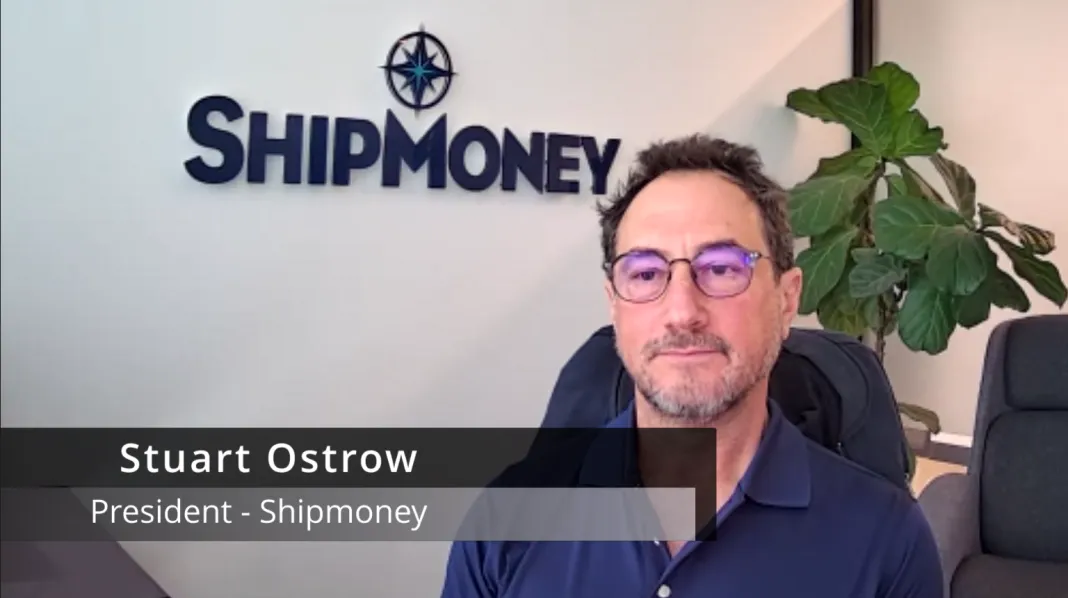
Paying crew fairly, on time and in a compliant way is not always simple when people live and work across borders. In this interview with Maritime Innovations, ShipMoney President and Founder Stuart Ostrow explains how digital payments are helping shipowners reduce costs, improve crew welfare and move away from cash on board. He also shares how ShipMoney’s solutions support mixed-nationality crews across both cruise and commercial fleets.
Below you can read the full feature, originally published by Maritime Innovations, together with the video interview.
An exclusive interview with Stuart Ostrow, founder of ShipMoney, reveals how digital solutions are solving age-old payment challenges in the maritime industry
The maritime industry has long struggled with a fundamental challenge: how to efficiently pay crew members from dozens of different countries while vessels operate far from traditional banking infrastructure. For years, the answer was simple but problematic—cash payments and expensive wire transfers. Today, maritime FinTech is addressing that challenge.
In our latest Maritime Innovations interview, we spoke with Stuart Ostrow, founder of ShipMoney, a Miami-based platform that has changed how the maritime industry handles crew payments. What started as a solution for cruise lines has evolved into a comprehensive financial ecosystem serving both cruise and commercial shipping sectors worldwide.
From Cash to Digital: The Genesis of Maritime FinTech
Ostrow’s journey began in the cruise industry, where he identified a critical gap in crew payment systems. “We recognized an opportunity whereby there was an industry that employed vast numbers of foreign nationals, and at the time, virtually paid all of its crew members in cash,” Ostrow explains. “If crew members are paid in cash, what do they do with that cash when they’re on board?”
The solution seemed straightforward but required innovative thinking. “We approached a company many years ago called Travelex, and we said, we have this great idea. Let’s take a wire service, attach it to a payroll card, and introduce it to the maritime industry, because it would fundamentally solve a problem.”
That simple concept has grown into a global standard. As Ostrow notes, “If you work on a cruise line anywhere in the world, you’ll get paid in one of these programs.”
Scaling Beyond Cruise Lines: The Commercial Shipping Challenge
Stuart Ostrow – President |

While cruise lines presented the initial opportunity, commercial shipping offered even greater complexity and potential. “The commercial space represented multiples of that opportunity, both in terms of crew and size of the space,” Ostrow explains. However, commercial vessels present unique challenges: “You don’t have 1000 individuals on a ship, you have 20, and you have crew members from all over the world, and there’s no such thing as international direct deposit.”
ShipMoney’s solution addresses these challenges through digital wallets that enable flexible remittance options. “Put the funds into an E-wallet, enable the crew member to send money home, however or wherever they want, to their family members, whether it goes to a bank account, whether it goes to an E-wallet, whether it’s a cash payout via Western Union or Money Gram,” Ostrow describes.
Security and Compliance in a Digital Age
Given the global nature of maritime operations and increasing cyber threats, security remains paramount. ShipMoney takes a comprehensive approach to protection. “We are vertically integrated in that we are both a program manager and a payment processor. So we have full control visibility regarding the transactions, maintenance of accounts, funding,” Ostrow explains.
The company employs multiple security layers, including proprietary fraud monitoring tools, regular penetration testing, and migration to AWS hosting environments. “We do external penetration testing on a regular basis. In fact, our pen testing is occurring as we speak,” Ostrow notes, emphasizing their proactive security stance.
From a regulatory perspective, ShipMoney operates under strict US financial regulations. “We abide by the FinCEN rules, reporting from a compliance standpoint, we do full KYC on our clients, on beneficial owners, on our account holders and the beneficiaries.”
Operational Efficiency: Real-Time Payroll Processing
One of ShipMoney’s most compelling advantages is processing speed. The platform can handle massive payroll operations with remarkable efficiency. “MSC Cruises, our largest cruise client, employs about 30-some thousand crew members, maybe more. They run a payroll file, and crew members will be paid in 10-15 minutes in one fell swoop,” Ostrow reveals.
This speed advantage extends beyond mere convenience—it addresses regulatory compliance requirements. “Crew members are paid contractually on the day that they’re due for MLC and IELC requirements,” Ostrow explains. “If payroll is due on the first of the month, at midnight on the first of the month, every crew member can get paid.”
Financial Freedom for Maritime Workers
Perhaps most importantly, ShipMoney’s platform provides crew members with unprecedented flexibility in managing their earnings. Traditional systems offered limited options: “Right now it’s a binary decision, get some cash on board, send a wire to a bank account,” Ostrow observes.
The new approach empowers crew members with choice. “What we really promote is financial freedom and flexibility to be able to remit payments, where, when, and to who at their discretion,” he explains. This flexibility proves particularly valuable in addressing personal circumstances that rigid banking systems cannot accommodate.
Implementation and Scalability
ShipMoney serves clients ranging from small operators with five ships to major lines with hundreds of vessels. While scaling to smaller clients presents challenges, Ostrow maintains his commitment to accessibility. “When I first started this company, somebody gave us a chance, and we were a little company, so I’ve never wavered from trying to work out how to make something scalable to smaller clients.”
Implementation typically requires about six weeks, though this can vary based on integration complexity and client requirements. “We always like to say we want to do it right. We don’t want to do it in a rush,” Ostrow emphasizes.
The Future of Maritime Finance
For shipping companies evaluating digital payment solutions, Ostrow’s advice is clear: “The one size fits all does not work in what we do.” Success requires platforms that can adapt to specific operational needs while maintaining the security and compliance standards that global maritime operations demand.
As the maritime industry continues adopting digital tools, platforms like ShipMoney represent a practical shift toward crew-focused financial solutions. By removing the constraints of traditional banking infrastructure and providing real-time, flexible payment options, these systems are changing how the industry approaches one of its most basic operational requirements.
This article is based on an exclusive interview with Stuart Ostrow, founder of ShipMoney. To hear the complete conversation and learn more about maritime financial innovations, listen to our full podcast interview on Maritime Innovations.